
The right underwear for hot Pilates — and what cotton actually does in a sweaty class
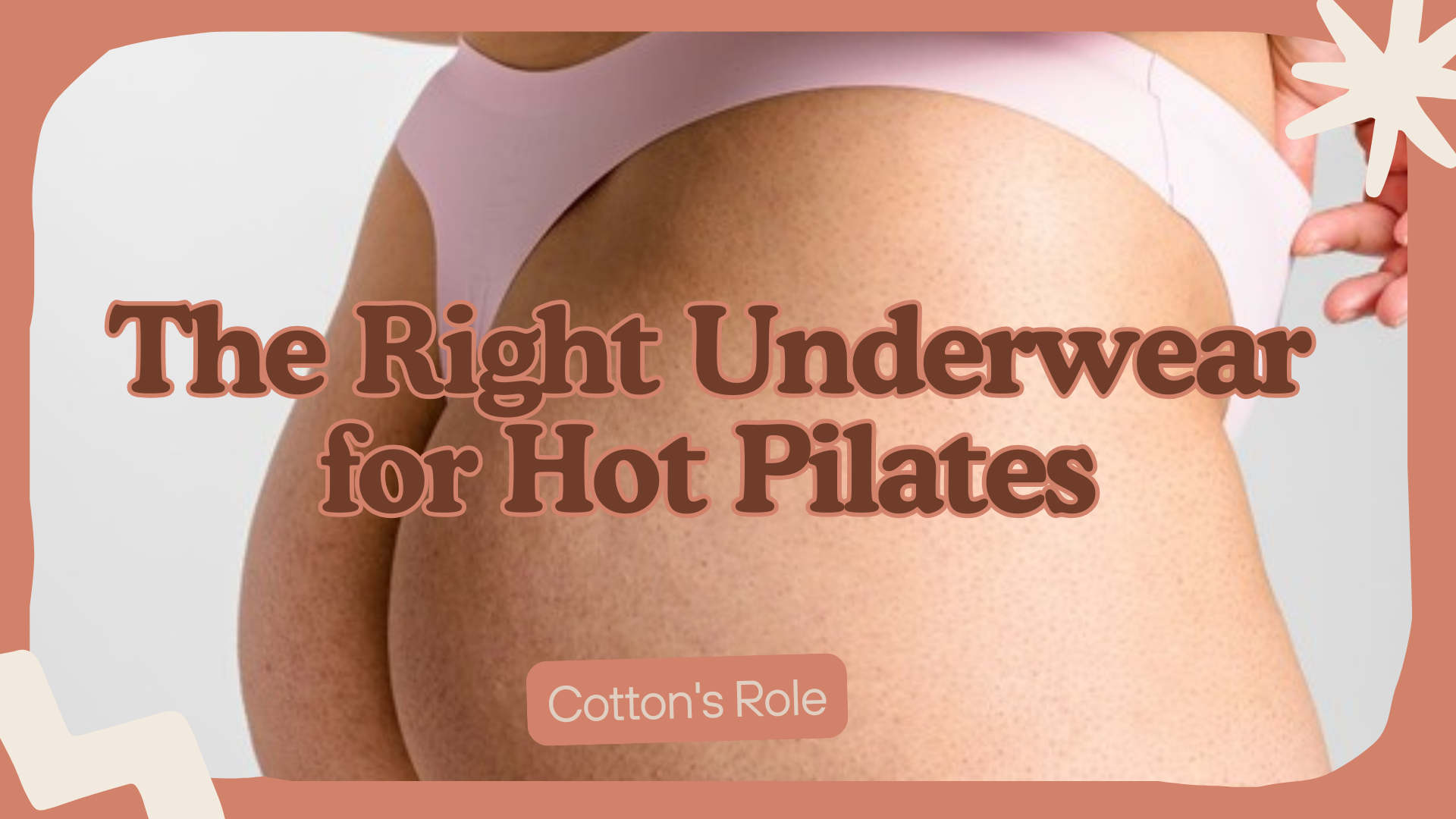
Hot Pilates is one of the few activities where what you wear underneath matters more than what you wear on top. The leggings don't have to do much — they're tight, they're stretchy, they're black. The underwear has to do everything: stay put through inversions, not bunch in the front during long-legged work, not get visibly damp through fabric, and somehow still feel comfortable 47 minutes into a class held in a 38°C studio.

Most underwear fails at least one of those tests. Cotton underwear fails all of them. Here's why, and what to wear instead.
What happens to cotton in a hot Pilates class
Cotton's job is to absorb. Across a 50-minute class with the room at 35-38°C, the average woman sweats between 200-500ml. In cotton underwear, all of that moisture gets absorbed into the fabric and held there.
By the time you're 20 minutes in:
- The fabric is heavy with sweat (cotton holds 3× its weight in water)
- It's clinging to skin, which causes friction during movement
- It's visibly damp through your leggings — the dark patch under leggings everyone pretends isn't there
- It's started to develop a smell, because warm damp cotton is a perfect bacterial substrate
By the end of the class:
- You've been chafed in at least one spot
- Your underwear is fully wet and will stay that way until you change
- There's a visible damp outline through your activewear when you walk to your car
None of this is necessary. It happens because cotton was the wrong choice for the use case.
The four-test fabric standard for hot Pilates
Underwear that works in hot Pilates passes all four of these tests. Most underwear passes maybe two.
Test 1: Wicks moisture away from skin
The fabric must move sweat away from your skin to the outer surface, where air can dry it. Cotton fails this — it absorbs and holds. Recycled nylon and other performance synthetics pass — moisture is wicked away in seconds, the inner surface stays mostly dry, and the outer surface dries between movements.
The simple test: drop a small amount of water on the fabric. If it soaks in and stays in one spot, it's absorptive (bad for hot classes). If it spreads out and starts to evaporate, it's wicking (good).
Test 2: No camel toe in long-leg movements
Reformer Pilates has a lot of single-leg work, splits, frogs, and elephant pose. Most G-string cuts pull into the centre during these movements, creating visible camel toe.
The fix isn't a different style — it's a different cut within the G-string style. A wider front panel (3-4cm wide instead of the typical narrow 1.5-2cm) sits flat through the centre and doesn't pull. Most "performance" underwear still uses the narrow front cut because it's cheaper to manufacture; check before buying.
Test 3: Stays put through inversions and twists
If your underwear shifts during teaser, scissor splits, or anything inverted, you're going to spend half the class adjusting. The fix is a flat, soft waistband (not stitched elastic, which slips) and bonded leg edges (not stitched, which roll).
The pinch test: pull the waistband or leg openings firmly. If they snap back tight and immediately, they'll stay put. If they stretch slowly back, they'll roll.
Test 4: Doesn't show through compression leggings
Pilates leggings are often thinner than gym leggings — they're cut for movement, not coverage. Underwear that's "no-show" under thicker gym wear can absolutely show through Pilates leggings.
The four design factors for invisibility (we cover them in our pillar guide) all matter here, but bonded edges and a one-piece back panel are the two that matter most for thin Pilates leggings.
The "go commando" myth
You'll see Pilates teachers and instructors recommending no underwear at all. The reasoning: "if you don't wear any, none of the problems exist."
True in theory, problematic in practice:
- Hygiene — leggings worn without underwear need to be washed after every wear, which most people don't actually do
- Modesty during specific movements — wide-leg straddles, frog pose, anything where you're upside-down with legs apart
- Comfort during seamed crotches — many leggings have a centre seam that's fine with underwear and uncomfortable without
If you're someone who washes leggings after every single wear and only does standard Pilates with no inversions, commando is a viable option. For most women, properly-designed underwear is a better trade.
What about period-friendly options for Pilates
This is the question we get most via email and the one most blogs avoid. Honest answers:
- For light flow days: a regular G-string with a quality cotton gusset works fine. The cotton gusset (not the synthetic body) is the part that handles light wetness.
- For medium flow days: most regular G-strings aren't enough on their own. Either pair with a properly-fitted tampon or menstrual cup, or wear a different cut (e.g. period-specific underwear) for the class.
- For heavy flow days: don't rely on underwear alone, regardless of brand. The cup-or-tampon backup is essential.
If you're hot Pilates with the room at 35°C+, even period-specific underwear can struggle with sweat saturation. The cup or tampon is doing more work than the underwear.
The post-class question: how fast does it dry?
If you're going from Pilates to anywhere else without changing — coffee, supermarket, school pickup — drying time matters. Cotton stays damp for 2-3 hours minimum. Performance underwear (recycled nylon blend) dries to about 80% within 30 minutes once you're out of the studio and wearing dry clothes over the top.
This is why women who switch from cotton to performance underwear for Pilates often start wearing it everywhere else too. Once you've experienced not being damp at 11am after your morning class, going back to cotton feels like a step down.
What we make, in case you're wondering
The Gym G was originally designed for hot Pilates and similar movement-heavy contexts. Recycled nylon blend with a cotton gusset, wide front panel (no camel toe), bonded edges, flat waistband, one-piece back. Built specifically to pass all four of the tests above.
Singles are $37. Most Pilates customers come back for a multipack — wear two pairs a week to class, two more for everyday, rotate through the week without thinking about it.
Further reading
- The complete guide to underwear that disappears under everything — our pillar guide
- Underwear under leggings: the no-VPL guide — same fabric, different angle
Questions? Email hello@barethrills.com — we read every message.